
PRP to stimulate Hair Regrowth
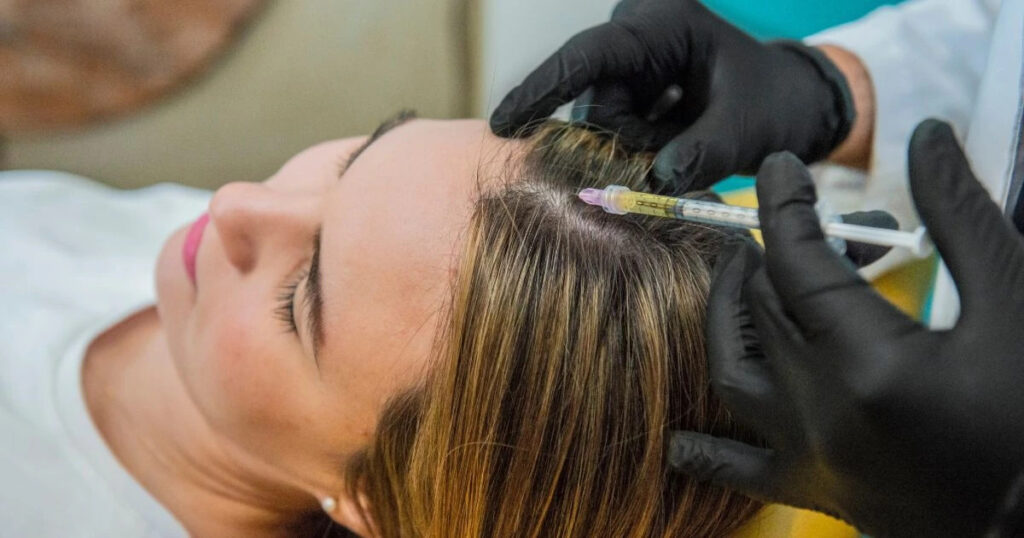
A couple of months ago we examined the case for Platelet-Rich Plasma (PRP) therapy as a cosmetic procedure. If you missed this article it is still available to view on our website pattayatrader.com.. The procedure commonly known as “The Vampire Facial” literally uses blood drawn from the patient for the injections. This month we look at this non-surgical procedure for the treatment of hair loss.As, by harnessing the body’s own natural healing mechanisms, PRP injections offer a scientifically grounded approach to stimulating hair regrowth and slowing the progression of hair thinning.
As with all PRP procedures the blood once extracted from the patient is placed in a centrifuge, which spins at high speed to separate its components. The result is a concentrated solution of platelet-rich plasma which can be injected exactly where required. It contains growth factors at levels significantly higher than what normally circulates through the body.These include platelet-derived growth factor (PDGF), vascular endothelial growth factor (VEGF), transforming growth factor (TGF), and insulin-like growth factor (IGF). So when injected into the scalp, these growth factors work together to stimulate dormant or weakened hair follicles, encouraging them to enter and sustain the active (anagen) phase of the hair growth cycle.
The beauty of using the patient’s own blood is that there is no allergic reaction so this platelet-rich solution can be injected directly into the scalp at the level of the hair follicles to stimulate growth.The entire process typically taking less than a couple of hours which includes time to allow for numbing cream to be applied and take effect. This along with an ice compress used before injecting make the procedure as painless as possible. It is also an attractive option for people who want effective treatment without the recovery time associated with surgical hair restoration.
PRP also promotes angiogenesis (the formation of new blood vessels) which improves circulation to the scalp and ensures that hair follicles receive a richer supply of oxygen and nutrients. This improved follicular environment is essential for producing thicker, healthier strands of hair over time making the therapy particularly effective for individuals suffering from androgenetic alopecia, the most common form of hair loss, affecting both men and women. In men, this presents as a receding hairline and thinning at the crown; in women, it typically manifests as diffuse thinning across the top of the scalp.
The treatment tends to work best in patients who are in the earlier stages of hair loss, where follicles are still present but have become weakened. PRP is less effective in areas where follicles have been completely lost for an extended period. So getting treatment as an early intervention is a key factor in achieving the best outcomes. Beyond alopecia, PRP has also shown promise for patients experiencing hair thinning following hormonal changes, nutritional deficiencies, or general stress-related shedding. In trials research has consistently shown that patients receiving PRP injections experience measurable increases in hair density, hair shaft diameter, and the number of follicles in the active growth phase. In many trials, results were visible within three to six months of beginning treatment, with continued improvement observed after a full course of sessions.
One advantage frequently noted in clinical settings is that PRP not only helps regrow hair but also improves the overall quality of existing hair. Patients often report that their remaining hair becomes visibly thicker and stronger, which can produce a significant cosmetic improvement even before new growth becomes apparent.Side effects are generally mild and temporary, typically limited to minor scalp tenderness, redness, or swelling at the injection sites, all of which resolve within a day or two.This makes PRP a highly tolerable option for people who are not candidates for, or who prefer to avoid, medications such as minoxidil or finasteride, both of which can carry their own side effect profiles.
PRP is not a one-time cure. Most protocols involve an initial series of three to four monthly treatments, followed by maintenance sessions every three to six months to sustain results. However, for those seeking a treatment grounded in the body’s own biology, PRP injections represent a compelling option. Offering a meaningful opportunity to slow hair loss, revitalize weakened follicles, and restore confidence,all without surgery and with minimal downtime.