
PATTAYA—The pushing, jabbing, and slapping were bad enough. But combined with cruel words of abuse, they left a five-year-old in tears and hating school. But she was tough, She dried her tears before coming home and acted like nothing happened, but her father knew something was wrong. One evening, he confronted her—and it all poured out. Nadthawan Panthong told her father about the bullying at school. Abusive language and physical altercations were pushing her into emotional withdrawal. Her father, Wisanlek, realized drastic action was needed to avoid the potential of life-long trauma and consequences. So he taught her Muay Thai.
Under his guidance, she overcame the bullying in her hometown of Rayong. but her father realized, she had more going for her than basic skills. She had talent. Determination. Courage. In time, fighting under the name Stamp Fairtex, she would win 64 professional matches and four world championships—and she would pioneer the sport for women around the country.
Stamp won her first fight at age six, using knee blows to knock out her opponent. She became a Muay Thai champion of a local stadium and a two-division Eastern Thailand winner. These early years of Stamp’s career were featured in the 2012 documentary, Buffalo Girls.
As an adult, she moved to the Fairtex Gym in Pattaya, where she also trained in Brazilian jiu-jitsu. Stamp, now 28, has won a gold medal at the 2019 Siam Cup BJJ tournament in the women’s 58.5 kg class. She is a three-sport world champion in Muay Thai,
Kickboxing, and MMA, formerly holding the ONE Women’s Atomweight World Championship (2021).Stamp now leads a new generation of champions along with Smilla Sundell, Saemapetch, and Ferrari out of the Fairtex Gym. But Stamp’s Muay Thai
journey, like the others, has continued a tradition that began nearly 800 years ago.
In 1238, the first Thai army was created in the northern city of Sukhothai to protect the government and the city’s people. Training included hand-to-hand combat, the use of weaponry, and perfecting of the body as a weapon. Muay Thai and Krabi Krabong both evolved from this training. Under constant threat of war from Burma and Cambodia, the first Muay Thai camps formed. These camps were training centers set up throughout the kingdom.
Young men practiced self-defense, exercise, and discipline, creating large armies to protect the Thai Kingdom. During the Era of King Narai, Muay Thai became a national sport, with fundamental standards set for the next 400 years. n those days, local champions represented their city or village. Mostly, they represented wealthy businessmen or royalty in dispute settlements.
But the greatest Muay Thai hero is Nai Khanom Tom—and his legend began with a choreographed dance! During the 1767 invasion of the Burmese troops in the ancient capital of Ayutthaya, Nai Khanom Tom was one of many Thai residents taken prisoner. A few years later, the King of Burma organized a seven-day, seven-night celebration in honor of the Buddhist pagoda. Royal presentations of combat took place between Thai and Burmese fighters in a boxing ring set up in front of the throne. On the first day of celebrations, Tom was matched with a skilled Burmese boxer. But the fight started oddly.
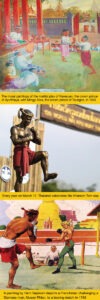 Tom perplexed the crowd by beginning the match with an intricate dance that he performed around his startled opponent. Known as Wai Kru, this dance was a symbolic gesture of thanks to the fighter’s mentor, but the Burmese did not understand the gesture of goodwill. Instead, they thought they saw a man possessed by dark forces.
When the match officially began, Tom threw a series of elbow blows to the chest that quickly overpowered his opponent. Within minutes, Tom was standing victorious over his fallen foe. But the match was ruled unfair due to “black magic.” Tom was too good to be real! The referee claimed the Wai Kru dance led the opponent to be distracted. Because of this, Tom had to fight nine more Burmese boxers. So much for his dance routine! Focused on fighting, he was able to defeat each of the boxers, including an instructor, an achievement shocking both the royal family and spectaors alike.
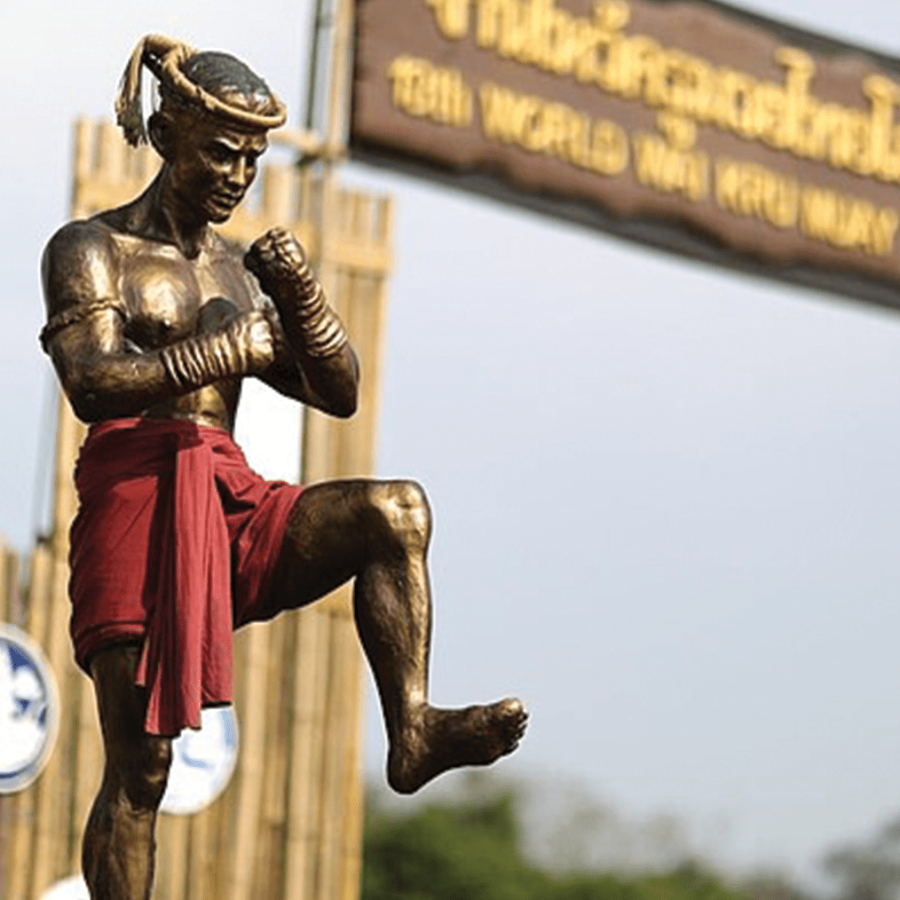
Every year, the ancient capital of Ayutthaya hosts the World Wai Kru Muay Thai Ceremony. Attendees learn about Muay Thai’s history, pay respects to great masters, witness live matches, and test basic techniques themselves. During the Ratanakosin
Era (1782-`1932) rules and regulations for Muay Thai were born although it got a little “nutty.” The rounds of each fight were counted in an unusual way–with coconuts. A small hole was pierced into a coconut and placed in a water barrel. Once the coconut filled with water and sunk to the bottom of the barrel, the round ended.
In World War II, Muay Thai fighters introduced the sport to France. Thai soldiers stationed there would perform Muay Thai to boost morale. At times, the soldiers also would compete against French boxers. After the war, retired soldiers became “Kru Muay” (sport instructors).
For centuries to follow, Muay Thai became a vital part of the Thai culture. Skills were passed from generation to generation. The love of the sport continued to grow as well as the importance of the sport as an effective kingdom defense system.
Today, modern weapons have replaced the old fighting traditions. However, the spirit of Muay Thai lives on as a national sport—and one Stamp Fairtex firmly believes in!