
By Songpone Siriwanlert
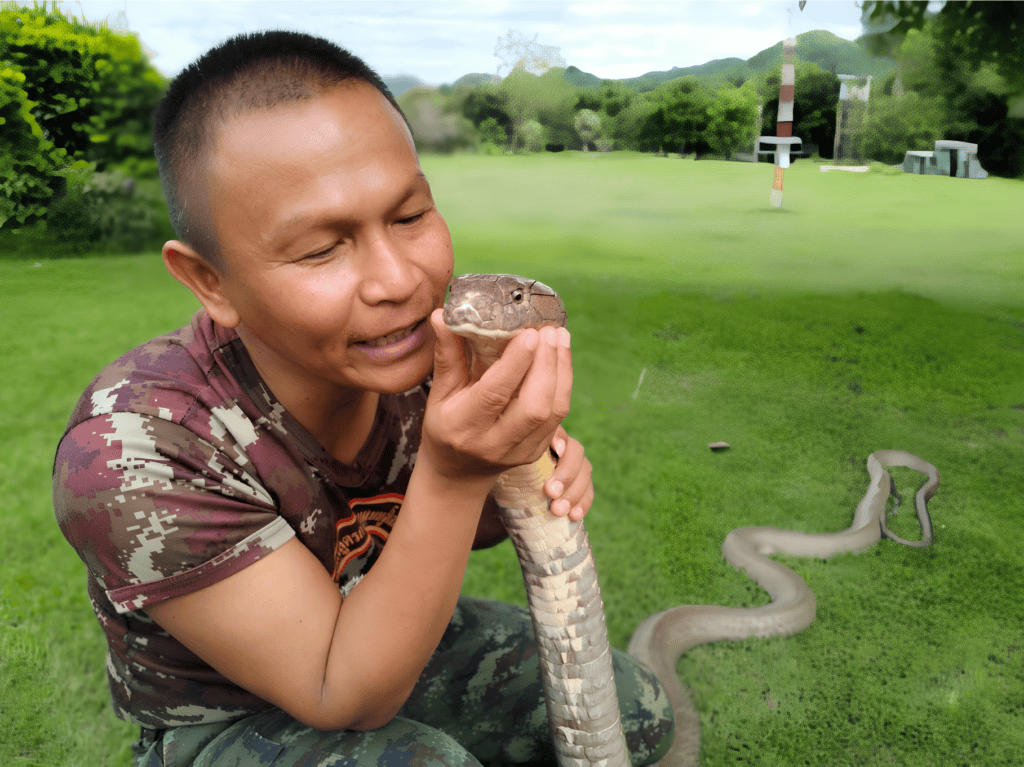
Do you believe it? The king cobra can actually be tamed.
The king cobra is the largest venomous snake in the world, possessing the highest volume of venom and the most lethal toxicity. It can be found in every region of Thailand. It is classified as a protected wildlife species under the Wildlife Protection Act, which means catching, killing, or keeping them as pets is strictly prohibited.
They are considered animals that maintain the natural balance of the snake population because, by nature, they prey on all types of snakes. This includes venomous snakes like monocled cobras, as well as non-venomous ones like mangrove snakes, Indochinese ratsnakes, and radiated ratsnakes.
King cobras are usually fierce due to their defensive instincts, and they can rear up and flare their hoods, raising their bodies as high as 1 to 1.5 meters.
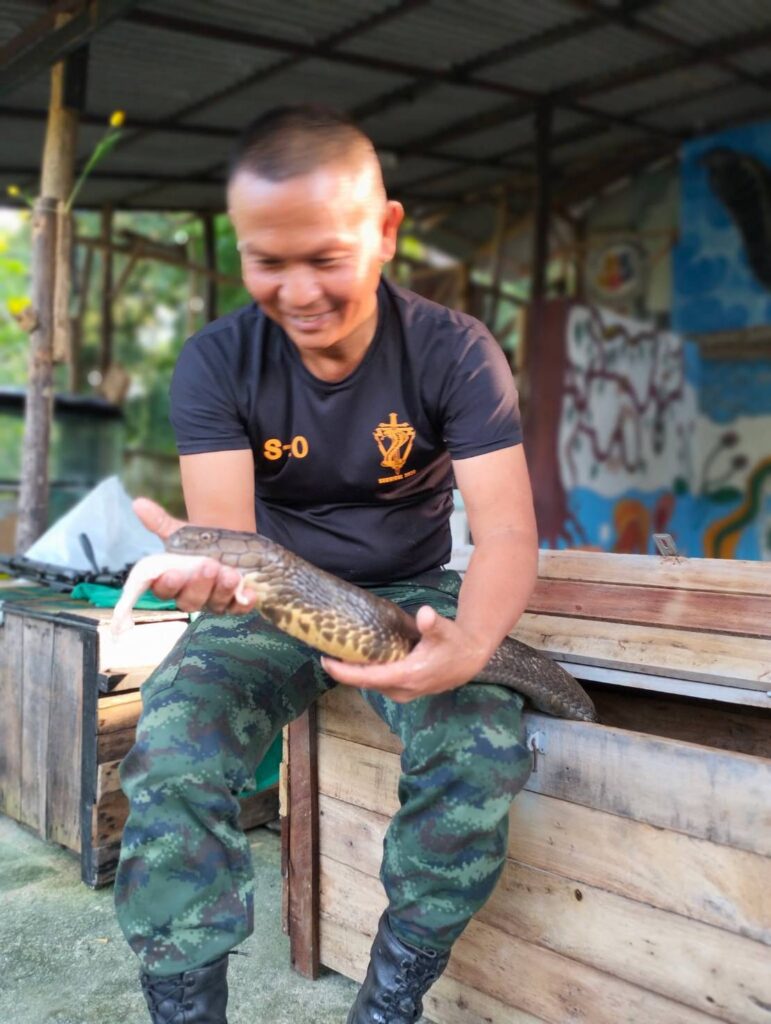
The Kaeng Krachan Special Warfare Training Camp in Phetchaburi Province has a special unit tasked with taming king cobras.
The objectives are to educate the general public and to harvest venom to produce anti-venom to save snakebite victims.
Taming a king cobra is no easy feat—it is not like training a tiger or a lion. King cobras possess defensive instincts, are aggressive, venomous, and know how to bite from the moment they hatch, regardless of what age you start training them.
The king cobras brought in for training are sourced from the wild; some are injured and brought in for medical treatment, including those injured by the equipment used by rescue teams when catching snakes that entered people’s homes before transferring them here.
Snake taming must be performed by experts who are highly experienced and skilled in snake handling. The general public must not attempt to copy this, as it is life-threatening and carries a high risk of snakebites.
The training takes a very long time, requiring building familiarity and trust between the snake and the handler. Tameness develops gradually in stages, ranging from level one up to the highest level where they can become pets.
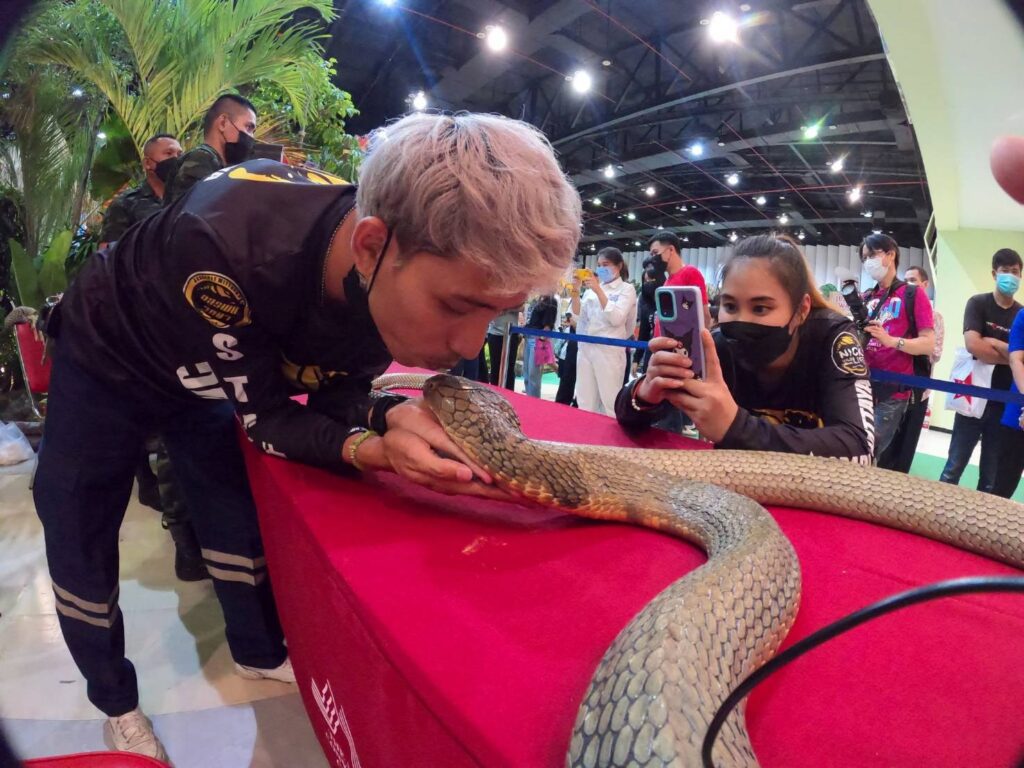
At this ultimate level, they develop affection and a bond with humans, allowing handlers to pick off ticks for them (snakes also get ticks lodged between their scales, much like dog ticks that attach to skin under the fur), bathe them, rub them down with soap and shampoo, rinse them off, help them shed their skin, and hand-feed them water and food.
At the training unit, they feed them cooked chicken breast. Once the level of tameness is high enough for them to become pets, they can be brought out for visiting members of the public to touch, hold around their necks, or wrap around their arms.
The snakes will slither and wrap around the arms without flaring their hoods or rearing up in a defensive stance like normal wild king cobras.
The unit has friendly king cobras that can be taken out to swim in the reservoir, and they even have their own names, such as Chero, Shin-chan, and Bigfoot. Anyone who is interested and wishes to change their attitude regarding their hatred and fear of snakes can visit the activities of the King Cobra Training Unit at the Kaeng Krachan Special Warfare Training Camp in Phetchaburi Province.
Credit: Facebook Page: Captainsnake return, Kaeng Krachan Special Warfare Training Camp, Phetchaburi Province