
Tai chi is becoming more and more popular not only as a traditional Chinese internal martial art but also as a gentle form of regular exercise. I was particularly struck by how calm and peaceful it looked when I was in Vietnam and saw a sweet, older couple practicing tai chi by Hoàn Kiếm Lake in Hanoi at sunrise. With their graceful, flowing movements perfectly timed together, it seemed to me that this was their routine and habitual early-morning exercise.
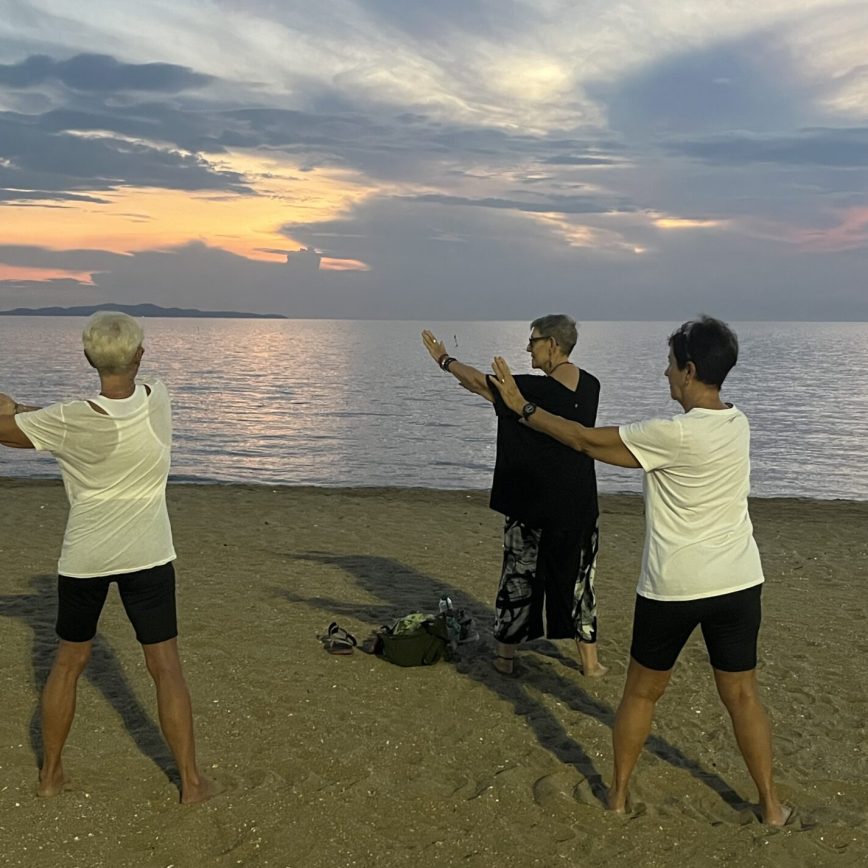
So I was delighted to discover that Lizzie, a long-time exponent, has just started inviting people to practice an hour of tai chi with her on Jomtien beach at sunset. From 5:15 p.m. on a Friday, anyone is invited to join her on the stretch of beach in front of Café Le Mar, free of charge. I went to watch and take photos in what seemed to be an idyllic setting. The YouTube videos I have followed with various instructors all mention the importance of grounding oneself to the earth when performing the exercises. What better way to do that than to be barefoot on the sand, enjoying a gentle sea breeze and watching the sun go down as you exercise?
Tai chi originated in China centuries ago in Henan Province. Blending martial technique, meditative awareness, and principles from Daoist philosophy, it quickly found popularity throughout Asia and today is practiced worldwide both as a form of self-defense and as a gentle exercise to promote physical and mental well-being. There are several major styles, each with unique characteristics. Yang style is the most widely practiced and is defined by an even tempo and expansive, gentle movements, making it particularly accessible to beginners and older adults. However, all forms of tai chi share the same underlying philosophy of relaxation, rooted posture, and mindful intention.
As I mentioned, YouTube offers many videos you can try at home to see whether tai chi is something for you. Because the practice is low-impact and adaptable, people of nearly any fitness level can try it to enjoy a wide range of benefits. Physically, tai chi exercises can improve your balance, coordination, and leg strength by controlled shifting of weight and continuous motion. Its slow, mindful sequences enhance joint mobility and can be especially helpful if you are managing arthritis or recovering from injury. Built on the concept of yin and yang, movements alternate between soft and strong, rising and sinking, expanding and contracting. Practitioners aim to maintain a relaxed body, an attentive mind, and a steady flow of qi, the vital life energy.
While at-home videos are a great starting point, they cannot watch and correct you. Having someone who knows how it “should be done” right in front of you is invaluable, as they can gently adjust posture and form as needed. While watching Lizzie on the beach, I noticed that she constantly monitored the ladies in front of her, checking their stance and alignment to help them get the most from the practice.I also noticed that for the first part of their hour, Lizzie led them through some Qigong movements. Pronounced “chee-gong,” this is another traditional Chinese practice closely related to tai chi but based on simpler, slower, and gentle movements, with a strong focus on breathing. Practicing qigong can act as a form of moving meditation, and it seemed to me to be a natural progression to move from this into tai chi. The emphasis on breath, posture, and body awareness must help reduce stress and anxiety.,
At its core, tai chi is a holistic discipline that unites the body, mind, and spirit through coordinated breaths and deliberate motions. Unlike many martial arts that emphasize speed or brute strength, tai chi cultivates “soft power”: the ability to neutralize force through sensitivity and balanced structure.I believe many studies have also shown that tai chi also supports cardiovascular health, flexibility, and core stability, while reducing the risk of falls among older adults.So whether pursued for fitness, meditation, or just to slow down and breathe with intention, it seems to me to be the type of exercise easy to learn and continue with . Why not give it a try for yourself? Let it be the first of your New Year’s Resolutions!