

I remember when making a record meant booking an expensive recording studio, hiring musicians and a record company picking up the bill?
Then, if you wanted a music video, you needed a film crew, a director, a location and a budget that would make your bank manager faint.
Well, welcome to 2027, where the entire entertainment industry could be sitting on your laptop!
As a musician, songwriter and producer, I’ve witnessed some extraordinary changes in technology over the years. From analogue tape to digital recording, from vinyl to streaming, every revolution has promised to change the music business forever. But artificial intelligence could be the biggest game changer of them all.
-
The AI Recording Studio
A.I. music platforms such as Suno are already producing remarkably convincing songs from a few simple instructions.
By 2027, we can expect these tools to become even more sophisticated, giving songwriters greater control over arrangements, individual instruments, vocals and production.
But there’s a rather awkward question. If everybody can make a great-sounding record, what actually really makes a great record? The song maybe?
-
Hollywood on a Laptop
Perhaps the most exciting development for independent musicians is A.I. generated video. Imagine creating a music video in which you’re performing on the moon, driving through Hollywood in a classic sports car or singing with a hundred-piece orchestra in an ancient Roman amphitheatre.
All without leaving your home studio.
Video generation platforms such as Kling, Runway and Google’s Flow are already making extraordinary things possible. In 2027, we could see longer, more realistic video sequences, consistent characters, better lip-syncing and increasingly affordable production costs.
The independent musician is becoming a film director, cinematographer, editor and special effects department all rolled into one.
-
The Virtual Pop Star
Then there’s the intriguing possibility of entirely artificial pop stars.
Virtual performers could release albums, appear in music videos, interact with fans and even headline spectacular digital concerts. But will audiences develop the same emotional connection with a computer generated personality as they do with a real human being?
-
The Return of the Music Video
Back in the golden age of MTV, music videos were events. They could make or break a record. Artists competed to create something memorable, outrageous or visually stunning.
Could 2027 bring about a new golden age of the music video? With production costs potentially tumbling, even relatively unknown artists could create visual masterpieces to accompany their songs.
The challenge, of course, will be standing out in an increasingly crowded digital world.
-
The Human Touch
Ultimately, I believe the most valuable ingredient in music will remain something technology cannot easily manufacture: the genuine human experience.
A heartbreak, a wonderful memory, a funny observation or a melody that makes the hairs on the back of your neck stand up. These are the things that make music matter.
A.I. is an extraordinary creative tool, but a tool is only as interesting as the imagination of the person using it.
In 2027, technology may finally allow us to create almost anything we can imagine.
The question is no longer whether we can make it.
It’s whether we have something worth making.
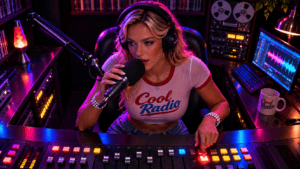
Pictured: scenes from Barry Upton’s new updated, remixed and re-edited original video track utilising A.I. and some scenes from the original 1996 video.
– Hey! You On The Radio – 2026
Check it out on YouTube.