
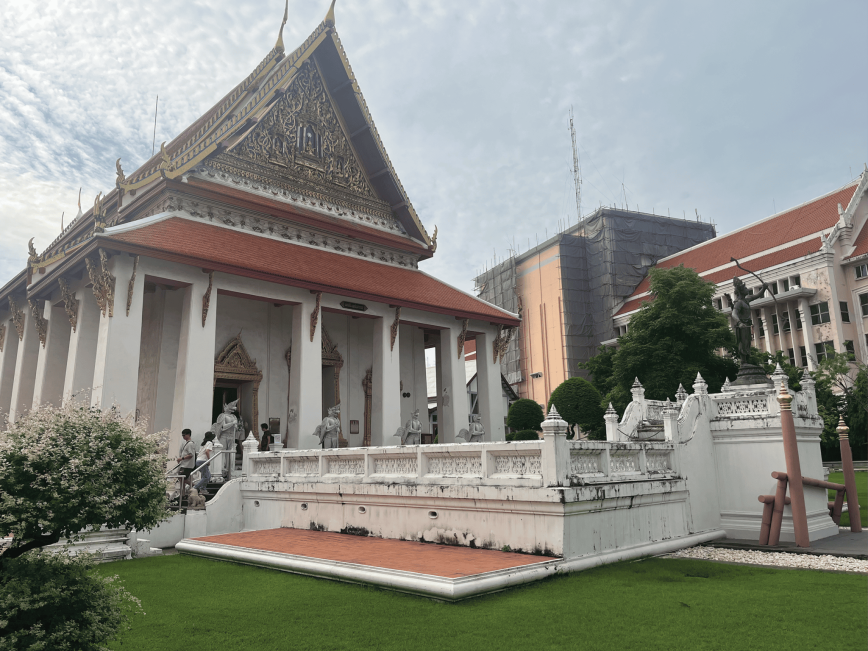
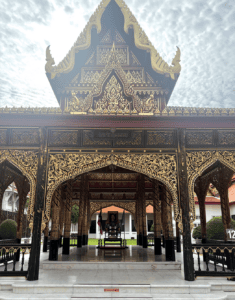
Situated on Na Phra That Road in Bangkok’s historic Phra Nakhon district is the Bangkok National Museum. One of the largest and most important museums in Thailand. If you want to get a broad understanding of the country’s history, art, religion and royal traditions all in one place,then this museum provides an invaluable introduction. It also has another important distinction in that it stands on the site of the former Front Palace, the residence of the Uparaja, often translated as the Vice King or Second King, for much of the early Rattanakosin period.Its Khachakamprawet Pavilion was built on the occasion of the celebration of King Pinklao’s coronation as the Second King at the behest of King Mongkut (Rama IV). The term Khachakamprawet coming from the Sanskrit compound “gajakarmapraveshana” which means “the way to an elephant”. This is because in the past it had a platform for mounting an elephant and later in the reign of Khin Chulalonkorn the Great (Rama V) it was used as a ritual venue for the Royal Ploughing Ceremony.
King Chulalongkorn (Rama V) also established the museum itself in 1874 to display royal antiquities and objects collected by his father, King Mongkut (Rama IV). The original museum was located within the Grand Palace before the collection was transferred to the former Front Palace. Later in 1926 the institution was renamed the Bangkok Museum, finally becoming the Bangkok National Museum in 1934.Today, the museum is administered by Thailand’s Fine Arts Department, under the Ministry of Culture. Its role goes beyond simply displaying historic objects. It is responsible for preserving, researching and interpreting important examples of Thailand’s archaeological and artistic heritage.
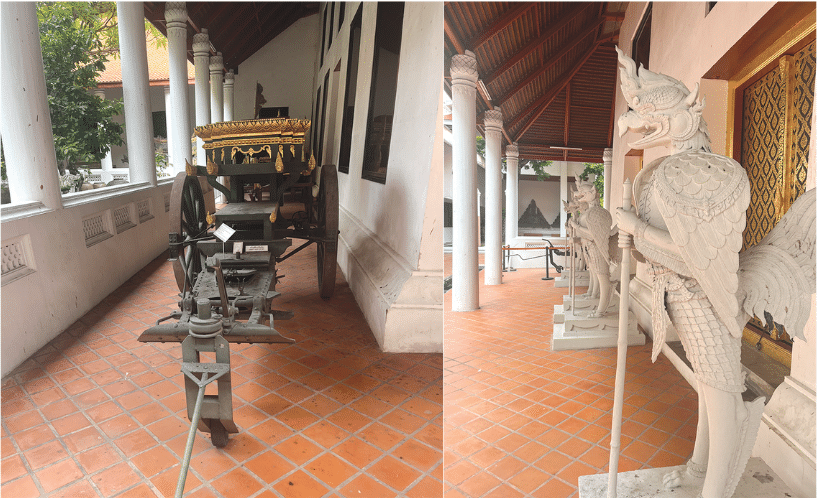
When you walk around this impressively large site you will see that rather than everything being housed in a single modern building the collections are spread across a group of historic structures. Among these are the Siwamokkhaphiman Hall, Buddhaisawan Chapel and Issara Winitchai Throne Hall, each with its own architectural and historical significance. The collections housed therein cover an exceptionally broad period. From archaeological displays of prehistoric communities through the various cultures and kingdoms that influenced the development of Thai civilization. Important collections relating to the Dvaravati, Khmer, Sukhothai, Ayutthaya and Rattanakosin periods show how artistic styles, religious beliefs, political structures and international influence changed over many centuries.
The Buddhist art collection is particularly significant as the museum contains many Buddha images and religious objects that provide an opportunity to see how the representation of the Buddha evolved over time, from early Indian-influenced forms through to distinctive Thai styles.
The museum also helps visitors understand the importance of Ayutthaya, which was the capital of the Siamese kingdom from 1350 until its destruction by Burmese forces in 1767. Visitors can also see royal regalia, ceremonial objects, weapons, clothing, furniture and other exhibits that provide an insight into the ceremonies and traditions associated with the royal court.
Another important aspect of the museum is its role in preserving traditional Thai craftsmanship with collections of ceramics, lacquerware, textiles, wood carving, weapons, musical instruments and decorative arts. Working on several levels it is an archaeological museum, an art museum, a museum of royal history and a centre for the preservation of Thailand’s cultural heritage. Therefore, extremely useful for visitors coming to appreciate all these subjects in one historic location.However, before planning a trip it is important to check the museum’s opening times, currently;
Open Wednesday to Sunday from 8.30am to 4.00pm and closed on Mondays and Tuesdays. At 4 Na Phra That Road, Phra Borom Maha Ratchawang, Phra Nakhon, Bangkok. http://www.virtualmuseum.finearts.go.th/bangkoknationalmuseums/index.php/th/ An important museum for anyone interested in discovering how the modern Kingdom of Thailand developed from its prehistoric roots, through Sukhothai and Ayutthaya, to the Bangkok era, it is one of the city’s essential cultural institutions.