

The Story of Nai Khanom Tom and the Burmese King.
The Burmese king stared down at the lone foreigner in the fighting pannung. Seated in the royal gallery, King Mangra looked over the well-built Thai prisoner standing in the fighting ring as hundreds of Burmese pounded bamboo fence posts and yelled for blood in the packed arena. There is something in his eyes. Something different.
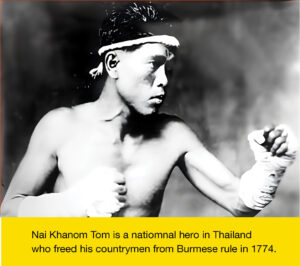 A ruler more ambitious than fair, King Mangra knew the power of psychological propaganda in his on-going war against Siam. He looked to make a mockery of his Thai captives, forcing them to fight against his honor guard of champions. During the 1767 Burmese invasion of the ancient capital of Ayutthaya seven years earlier, Nai Khanom Tom was one of many Thai taken prisoner. Now King Mangra had organized a seven-day, seven-night celebration in honor of the Buddhist pagoda. But he had ulterior motives. On the other hand, Tom and his people had toiled as prisoners of war. Now there was a chance to regain respect and dignity!
Tom looked down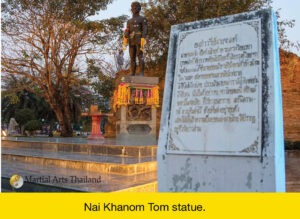 respectfully but with a humble determination. At stake were his family, his village, and his country’s reputation and survival. Burmese fans chanted: Thay! Thay! (Die! Die!) The three Thai fighters before him had left unconscious, one with a broken neck. He saw two bloody front teeth in the dirt. He buried them with his bare right foot. Tom raised his head and eyes to the bedlam. “Thay! Thay!”
Tom panned the 10 champions with their hard looks and cold stares. The first one stepped out. He was stout, legs like tree logs, and eyes with a hint of dumb madness. The shouts of the crowd rattled the wooden poles: “Thay! Thay!” King Mangra signaled the fight to begin. All looked at Tom. So what did he do? He danced! Tom perplexed the crowd with a Wai Kru dance. The symbolic gesture of good will silenced the now awestruck audience but some whispered “black magic.”
 King Mangra sat spellbound as Tom danced. In a rush of anger, the king turned to his top general and said, “We came here to humiliate our enemy and now he dances before us.” Crane and Tiger movements. Monkey steps. A twirl here. An elbow to the ribs there. Roundhouse kicks here and there. Tom danced and pummeled the shocked man into submission. One down. Nine to go. A hush fell over the arena. King Mangra looked down sternly at Tom then burst into a hardy laugh. His people laughed with him.
Suddenly, a shaman ran into the ring shouting, ”Maunghmaw! Maunghmaw! (Black Magick!) The shaman cried out in gibberish about Tom’s “black magic dance.” He claimed it put a spell on the fighter and caused him to lose his mind. From now on, Tom must only fight not dance. The king shrugged. Then he waved his hand for the other fighters to continue the competition. One by one, they came out to face him. One by one, Tom knocked them out. No dancing. Mano a mano. King Mangra frowned: He thought to himself, I am losing my bet.
In a drunken rage six months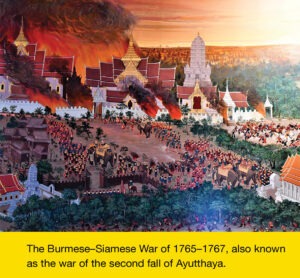 esarlier, King Mangra wagered gemstones against silk with a Chinese official that Burmese boxing was better than Thai Muay Boran. Filled with blind national pride and determined to prove his point, the king declared the event in celebration of Buddha despite other motives.. But he did not realize the limitations of boxing when pitted against a martial art. Each bout, he watched and lost watched and frowned. Until he realized his mistake went well beyond the fighting arena. Then he smiled to himself. So he watched them fight and lose. But he smiled. They fought Tom with traditional boxing technique limited to fist fighting. Tom understood their rigid style and used it to his advantage.
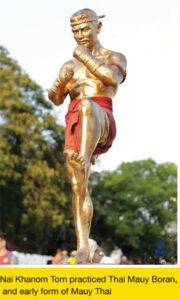
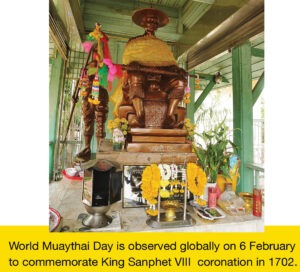 Known as “The Father of Muay Thai” or “the art of the eight limbs,” Tom practiced an early form of the sport known as Muay Boran so he possessed more flexibility and attack options and a freedom of movement and mobility that his opponents lacked. After six knockouts, the king said to the general, “Unless Kali comes to end the world today, I am going to lose my bet. Better to know the horse you’re racing against than the one you own.” Then there were none.
When the competition was over much to the amazement of the king and chagrin of the general Burmese fans ran past their fallen champions, bull-rushed Tom, and carried him around the arena cheering and shouting. They set him down before King Mangra. Tom humbly bowed then lifted his eyes. The king smiled.
Speaking with great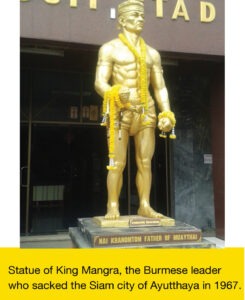 authority, the king said, “Today I learned a lesson and I am a new man. I came here to humiliate my enemy but I found out my enemy can fight … and he can dance!” All laughed. The king waved all quiet. They all looked at the fair king.
“Yes, I learned something about life today,” he continued. “I learned my enemy is not my enemy. He is the same as I am, the same as my people, and this competition has taught me it is better to fight our neighbors in the sporting ring than on the battlefield. Today I proclaim this an annual sporting event
between all our neighboring nations. An event of peace and unity. And, as for you, Nai Khanom Tom, you are free to return to your country, along with all the Siam captives from the war. You are our brothers and sisters, and it is time for lasting peace among Burma and Siam. The war is over! Let there be peace!”
On March 17, 1774, Tom led his people home—a event celebrated in Thailand each year as Mauy Thai Day!.